
Red Flags in Fragrance Export Paperwork: What Each One Usually Means
Paperwork is where a first premium launch gets its earliest warning. Long before a shipment is late, the document conversation shows whether a supplier has exported before: how quickly a file appears, whether answers name specific records or general capability, and whether the same question gets the same answer twice. None of these signals is proof of a problem on its own, but each one is cheap to notice and expensive to ignore.
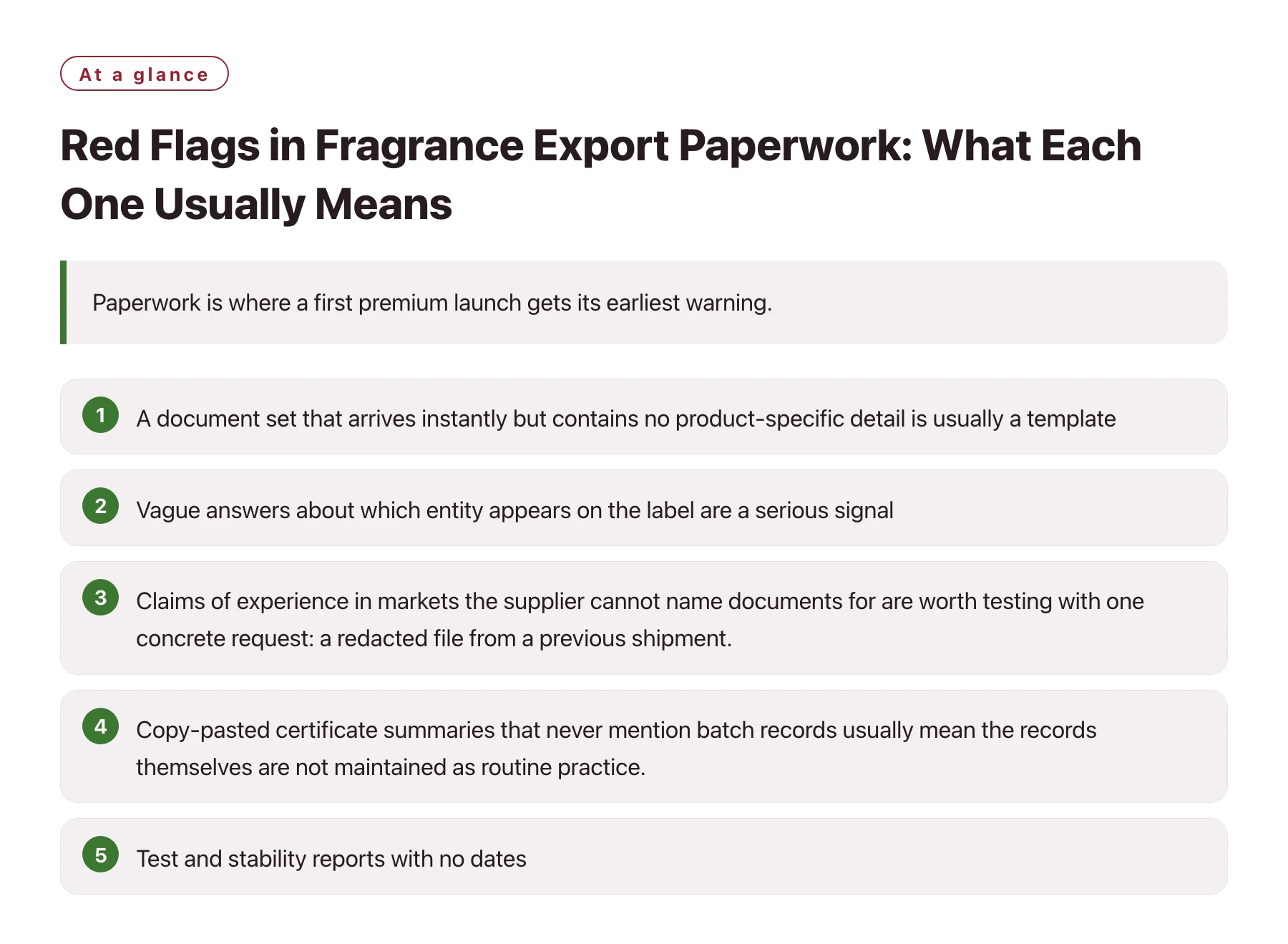
Key takeawaysA document set that arrives instantly but contains no product-specific detail is usually a template, not a file, and the difference appears when a market authority asks a follow-up question. · Vague answers about which entity appears on the label are a serious signal, because responsibility for a cosmetic product placed on a market sits with the party named on the pack [1]. · Claims of experience in markets the supplier cannot name documents for are worth testing with one concrete request: a redacted file from a previous shipment. · Copy-pasted certificate summaries that never mention batch records usually mean the records themselves are not maintained as routine practice. · Test and stability reports with no dates, no laboratory name and no lot reference cannot support a safety assessment, however professional they look. · A supplier that cannot explain the labelling requirements of the target market is unlikely to catch them, and the first launch is the worst time to find out [2].
First-time founders usually approach documentation with a mixture of deference and fatigue: the supplier is the expert, the file is technical, and the launch calendar is already tight. That combination makes paperwork the easiest place to be reassured by appearance rather than evidence, and it is why the warning signs below are worth reading before the first purchase order rather than during it.
The signals share a common shape. Real export practice produces specific, dated, named documents quickly, because the factory generates them as part of its work. Weak practice produces general statements, promises to provide things later, and answers that change shape when the same question is asked in a different meeting.
None of the seven points below is a reason to walk away by itself. Together they form a pattern that a founder can assess in a week of correspondence, which is a very cheap way to avoid learning the same lesson after the deposit is paid.
Seven warning signs and what they usually mean
- A file that arrives too easily and says nothing.If a complete-looking pack comes back within minutes and every page is generic, the supplier has sent templates. Ask for one document tied to one previous shipment, with the commercial data removed, and see how long that takes.
- No named laboratory, no dates, no lot numbers.Test and stability reports that lack an issuer, a date and a reference to what was tested cannot support a safety assessment. Ask who ran the work, when, and against which version of the formula.
- Uncertainty about who is named on the label.The entity identified on the pack carries the responsibility for the product in the market, so this is not a detail to settle later [1]. A supplier that has not thought about it has not exported a finished product under that regime.
- Certificates offered as proof of testing.A management system certificate says a system was audited; it says nothing about your batch. If certificates are the only evidence on offer, the batch-level records are probably thin.
- Market knowledge that stops at the port.Requirements differ between destinations, and a supplier claiming to serve a market should be able to describe its labelling and notification expectations without looking them up [2]. If every market gets the same answer, the answer is generic.
- A different answer to the same question.Ask a documentation question twice, weeks apart, through different people. Export practice is documented, so the answers match. Improvisation does not survive repetition.
- Reluctance to put document responsibilities in the contract.Who provides what, by when, in whose name, and what happens if a document is late: all of it belongs in the agreement. Resistance to writing it down is the clearest preview of how a problem will be handled later.
How to test the signals without becoming difficult
Founders often hold back from detailed questions because they do not want to appear inexperienced. The opposite is true: suppliers read careful questions as a sign of a serious buyer. The trick is to ask for things that already exist rather than things that have to be created.
A redacted document set from a previous shipment is the single most informative request available, and it is unremarkable in export trade. It shows record formats, naming conventions, dates and the level of product-specific detail in one exchange. If it cannot be produced at all, that is the answer.
A second useful test is to ask how a change would be handled. If the fragrance dosage changed, or the pack changed, or the destination changed, which documents would be reissued and who would pay. The answer reveals whether the supplier understands its own file as a living set of records or as a fixed pack of PDFs.
A third is to ask for the labelling inputs in the format the printer will use. Ingredient naming, allergen declaration and the responsible-party block are the pieces that hold up artwork, and a supplier familiar with export launches usually has them structured and ready. Anyone starting a first premium project benefits from reading how a manufacturer organizes that sequence at Visit the website before the first call, simply to know which questions have standard answers.
What good looks like, briefly
The opposite of every red flag is a supplier that answers from records. It names the laboratory and the date unprompted. It distinguishes system certificates from batch evidence. It knows which entity will appear on the label and why. It treats the redacted file request as routine, and it puts document responsibilities into the agreement before being asked.
That profile is not limited to large factories. Small, export-focused houses can be sharper on documentation than larger ones, because exports are their main channel rather than an occasional order. The useful comparison is not size but whether the questions have been answered many times before, which a short conversation usually makes clear.
Where first launches most often get caught
The typical first-launch problem is not a fraudulent file but an incomplete one. The safety assessment exists, the labelling inputs exist, and the batch records were never requested, so the buyer discovers the gap when a retail partner asks for traceability. By then the artwork is printed and the ship date is close.
The second most common problem is a mismatch of assumption: the buyer believes the factory holds responsibility for market compliance, and the factory believes it supplies documents for the buyer to use. Neither is wrong in principle, but leaving it unspoken is. Settling it at the contract stage is the cheapest correction available, and both sides benefit from a written division of what to check before choosing a perfume factory responsibilities before the project starts.
A third is the assumption that a private label arrangement comes with a ready-made compliance pack. It sometimes does and sometimes does not, and the difference is worth confirming early when the proposition is what a good private label perfume factory looks like. The questions are the same in both cases: which document, produced by whom, held by whom, and updated when.
If only one habit is adopted from this list, make it the repeated question. Ask the same document question in the first call and again three weeks later. Export practice produces consistent answers because it is written down; improvisation produces drift. Two matching answers will not prove a supplier is right for a premium launch, but two conflicting ones are close to conclusive, and they cost nothing to notice. Founders who want a baseline for what normal looks like can compare notes with the process material published by an OEM partner for perfume brands before the first meeting.
Sources
- European Commission: Cosmetics in the EU —— The European Commission's overview of EU cosmetics rules, including the responsible person, product information file and safety report requirements.
- Health Canada: Cosmetic Safety —— Health Canada's cosmetics pages, covering cosmetic notification, the ingredient hotlist and safety requirements for cosmetics sold in Canada.
Frequently asked questions
Is it a red flag if a factory cannot share another client's documents?
Not if the refusal is about confidentiality. What should be available is a redacted example that shows the format and structure without commercial or client information. Refusing to show a document at all, even in redacted form, is a different answer from refusing to disclose a client.
Should a first premium launch use an intermediary to handle export documents?
Some brands do, and it can work, but it adds a layer between the buyer and the records. If an intermediary is used, the contract should still name which documents the manufacturer provides directly, because traceability questions often need the producer rather than the agent.
How much documentation should be in place before paying a deposit?
Not the complete file, since parts of it can only be produced after the formula and pack are fixed. What should exist before payment is the division of responsibility in writing, an example of the supplier's record formats, and a clear statement of which documents will be issued at which stage.
What does a label's responsible-party block actually mean?
It identifies the entity accountable for the product on that market, which is typically the brand or its appointed representative rather than the factory. Because that party carries the obligation, founders should confirm early who will be named, and make sure the documents needed to support the position are obtainable.
Can paperwork problems be fixed after the first shipment?
Sometimes, but the cost is higher. Reconstructing a batch record months later depends on the supplier's archive and goodwill, and labelling problems may require reprinting. This is why documentation is best treated as a launch-critical path item rather than an administrative task that can be finished once the product is on its way.